Divorce Certificate Service in Canada Complete Guide to Legally Ending Your Marriage and Obtaining Your Certificate

Divorce certificate service is the professional solution that helps individuals in Ontario navigate the legal process of ending a marriage, obtaining official documentation of their divorce, and resolving related matters including custody, support, and property division with clarity, accuracy, and full compliance with court requirements. With procedural rules, mandatory waiting periods, and documentation standards that are unfamiliar to most people going through a divorce for the first time, attempting the process without legal guidance frequently results in rejected applications, avoidable delays, and outcomes that could have been better negotiated with professional support.
1. What Is a Divorce Certificate Service and Why You Need Professional Help
A divorce in Ontario is not simply the end of a personal relationship. It is a formal legal process governed by the federal Divorce Act and Ontario’s Family Law Act, administered through the Ontario court system, and concluded with the issuance of an official divorce order and, upon request, a divorce certificate. That certificate is the legal document that proves your marriage has been dissolved and is required for a wide range of practical purposes including remarriage, immigration applications, name changes, and estate planning.

While some divorces are straightforward and uncontested, the legal process that leads to a final divorce order involves precise documentation, correct court filings, compliance with mandatory timelines, and in many cases the negotiation or adjudication of significant issues including child custody, child support, spousal support, and the division of family property. A single error in how the application is prepared or filed can result in the court returning the documents for correction, adding weeks or months to an already difficult process.
A professional divorce certificate service does far more than complete government forms. A qualified legal professional will assess your eligibility for divorce in Ontario, prepare and file all required court documents correctly, advise you on related matters including support and property division, represent your interests in negotiations or court proceedings where disputes arise, and guide you through the process from first filing to final certificate with clarity and care.
At KT Law Firm, we assist clients through every stage of the divorce process with professionalism and genuine care for the outcome. We understand that divorce is a difficult and emotional time, and our role is to help you navigate the legal system efficiently while protecting your rights and interests every step of the way.
2. Understanding Divorce in Ontario: What You Need to Know
Before beginning the divorce process, it is important to understand the legal framework governing divorce in Ontario, what grounds are required, and how the process unfolds from initial filing through to the issuance of a divorce certificate.

2.1. Grounds for Divorce in Ontario
Under the federal Divorce Act, there is only one ground for divorce in Canada: marriage breakdown. Marriage breakdown is established in one of three ways:
- Separation for at least one year: This is by far the most common basis for divorce in Canada. The parties must have been living separately for a continuous period of at least one year before the divorce order is granted. Importantly, the divorce application can be filed before the one-year period is complete, provided that separation has already begun. The court will not grant the divorce order until the one-year period has been satisfied.
- Adultery: One spouse has committed adultery. This ground is rarely pursued in practice because it requires specific evidence and does not simplify the process in most cases.
- Physical or mental cruelty: One spouse has treated the other with physical or mental cruelty of such a kind as to render continued cohabitation intolerable. Like adultery, this ground requires specific evidence and is seldom used.
For practical purposes, the overwhelming majority of divorces in Ontario proceed on the basis of one year of separation, and the divorce process is typically planned around that timeline.
2.2. Uncontested vs. Contested Divorce
The complexity and duration of the divorce process depend significantly on whether the divorce is contested or uncontested.
Uncontested divorce: Both spouses agree to the divorce and have resolved all related issues including custody, support, and property division, either informally or through a separation agreement. This pathway is faster, less expensive, and generally less stressful than contested proceedings.
Contested divorce: The spouses disagree on the divorce itself or on one or more related issues. Contested matters proceed through a more formal litigation process that may involve case conferences, motions, and ultimately a trial if the issues cannot be resolved through negotiation or mediation.
Whether your matter is straightforward or complex, professional legal guidance ensures that your rights are protected and that the process moves forward as efficiently as possible.
2.3. What Is a Divorce Certificate and When Do You Need One
A divorce order is the court’s formal decision dissolving the marriage. A divorce certificate is a separate official document issued by the court upon request, typically after the divorce order has become final, that confirms the marriage has been legally dissolved. The divorce certificate includes the names of the parties, the date of the marriage, and the date the divorce order was granted.
A divorce certificate is commonly required for:
- Remarriage: Anyone wishing to remarry after a divorce must provide proof that their previous marriage has been legally dissolved
- Immigration applications: Many immigration processes, including spousal sponsorship applications, require proof of the dissolution of any prior marriage
- Name change applications: Reverting to a former surname following divorce may require presentation of a divorce certificate
- Estate planning and financial matters: Insurance policies, wills, beneficiary designations, and other financial instruments may require updated documentation reflecting marital status
- Foreign legal proceedings: Some countries require a Canadian divorce certificate authenticated for use in their jurisdiction
Understanding when you will need your divorce certificate and planning the application process accordingly is an important part of comprehensive divorce legal service.
2.4. Related Matters That Must Be Addressed
A divorce legally ends the marriage, but it does not automatically resolve the practical and financial matters that arise from the breakdown of a family unit. In Ontario, the following issues are frequently addressed alongside or in connection with the divorce proceedings:
- Child custody and decision-making responsibility: Determining where children will live and how decisions about their lives will be made
- Child support: Calculating and formalizing support obligations in accordance with the Federal Child Support Guidelines
- Spousal support: Assessing entitlement, amount, and duration of support payments from one spouse to the other
- Division of family property: Addressing the equalization of net family property under Ontario’s Family Law Act, including the matrimonial home, other real property, investments, pension assets, and debts
These issues can be resolved through a negotiated separation agreement, a consent court order, or contested litigation depending on the level of agreement between the parties.
3. Why Most DIY Divorce Applications Run Into Problems

Many individuals attempt to navigate the divorce process without legal assistance, particularly in situations that appear straightforward on the surface. Unfortunately, complications arise more often than expected, and the consequences of errors in family law proceedings can be both lasting and significant. Here are the most common problems:
3.1. Incorrectly Completed or Filed Court Documents
Ontario divorce applications require completion of specific court forms with precise and complete information. Missing information, inconsistencies between forms, or documents that do not comply with court requirements result in the clerk rejecting the filing and returning the application for correction. Each rejection adds delay to a process that is already governed by mandatory timelines.
3.2. Failure to Properly Address Related Family Law Issues
Many people focused on obtaining the divorce order itself do not give adequate attention to the related issues of support and property division. A divorce order can be granted while support and property matters remain unresolved, but failing to address these issues properly before or during the divorce process can result in lost rights, particularly with respect to property equalization claims, which have their own limitation periods under Ontario law.
3.3. Separation Agreement Errors
Individuals who negotiate their own separation agreements without legal assistance frequently produce documents that are unenforceable because they do not meet the legal requirements for a binding family law agreement in Ontario, contain terms that are inconsistent with the best interests of the children and therefore unenforceable by a court, fail to address all relevant issues leaving disputes to arise later, or do not properly disclose all financial information as required by law.
3.4. Underestimating the Emotional Impact on Decision-Making
Divorce is one of the most emotionally significant events in a person’s life. Decisions made under emotional stress, without legal guidance, frequently do not reflect the individual’s actual legal rights or long-term best interests. Professional legal support provides not only legal expertise but also the objective perspective needed to make decisions that will serve the client well beyond the immediate circumstances.
3.5. Not Understanding What the Divorce Certificate Covers
Many individuals conflate the divorce order with the resolution of all related issues. Receiving a divorce order does not mean that support, custody, and property matters have been resolved. Assuming that the divorce certificate closes all matters related to the marriage is a misunderstanding that can leave significant legal and financial issues unaddressed.
4. How Professional Divorce Certificate Services Maximize Your Success

4.1. Eligibility Assessment and Process Planning
Before any court documents are prepared, a professional assessment determines whether the eligibility requirements for divorce in Ontario are met, which basis for divorce applies to your situation, whether the one-year separation period has been completed or how to plan the filing timeline around it, and what related issues need to be addressed alongside the divorce application.
4.2. Divorce Application Preparation and Filing
Professional legal services ensure that all required court forms are completed accurately and completely, that all supporting documentation is gathered and prepared in the correct format, that the application is filed in the correct court location and in compliance with procedural requirements, and that the respondent spouse is properly served with the application in accordance with the rules of court.
4.3. Separation Agreement Preparation and Review
For uncontested divorces where the parties have reached or are close to reaching agreement on related issues, professional preparation of a legally sound separation agreement ensures the agreement is enforceable, comprehensive, and compliant with Ontario family law requirements. For clients presented with a draft agreement by the other party, professional review protects against agreeing to terms that are unfavorable or that waive important legal rights.
4.4. Negotiation and Dispute Resolution
Where issues including custody, support, or property division are in dispute, professional legal support enables structured negotiation aimed at reaching agreement without the cost and delay of contested court proceedings. This may include direct negotiation between legal representatives or participation in mediation, with the goal of producing a fair and practical resolution that can be formalized in a consent order or separation agreement.
4.5. Court Representation When Required
When disputes cannot be resolved through negotiation and court proceedings become necessary, professional legal representation ensures that your position is presented effectively, procedural requirements are met, your legal rights are advocated for at every stage, and the outcome of the proceeding reflects the full strength of your legal position.
5. The KT Law Firm Advantage: Why Experience Matters
When it comes to divorce certificate service, the guidance of an experienced legal professional makes a measurable difference not only in the efficiency of the process but in the quality of the outcome for every matter that goes beyond the divorce order itself.

5.1. Clear Legal Guidance Through a Difficult Process
KT Law Firm provides clear, practical advice at every stage of the divorce process. We do not use unnecessary legal jargon or create confusion about what is happening in your case. Our clients understand their rights, their options, and the realistic expectations for their matter from the very beginning.
5.2. Comprehensive Support from Filing to Certificate
Our divorce certificate service covers the full scope of the process: eligibility assessment, court document preparation and filing, separation agreement assistance, negotiation support, court representation where necessary, and guidance on obtaining the final divorce certificate after the order becomes absolute. Clients receive consistent, dedicated support from start to finish rather than being guided through only part of the process.
5.3. Practical Focus on Related Family Law Matters
A divorce order without properly resolved support and property issues is an incomplete legal outcome. KT Law Firm ensures that clients address custody, child support, spousal support, and property division matters alongside the divorce process in a way that protects their long-term legal and financial interests, not just their immediate desire to finalize the divorce.
5.4. Sensitive, Professional Client Service
We understand that divorce is a deeply personal and often painful experience. KT Law Firm approaches every client matter with genuine care for the person behind the legal process. Our goal is to make the experience as clear and stress-free as possible while ensuring that the legal outcome is one that serves the client’s interests fully and lastingly.
5.5. Support in English and Vietnamese
Our team provides professional legal support in both English and Vietnamese, ensuring that every client fully understands their legal situation, their rights, and the steps being taken on their behalf regardless of language preference.
6. Uncontested Divorce vs. Contested Divorce: Understanding Your Pathway
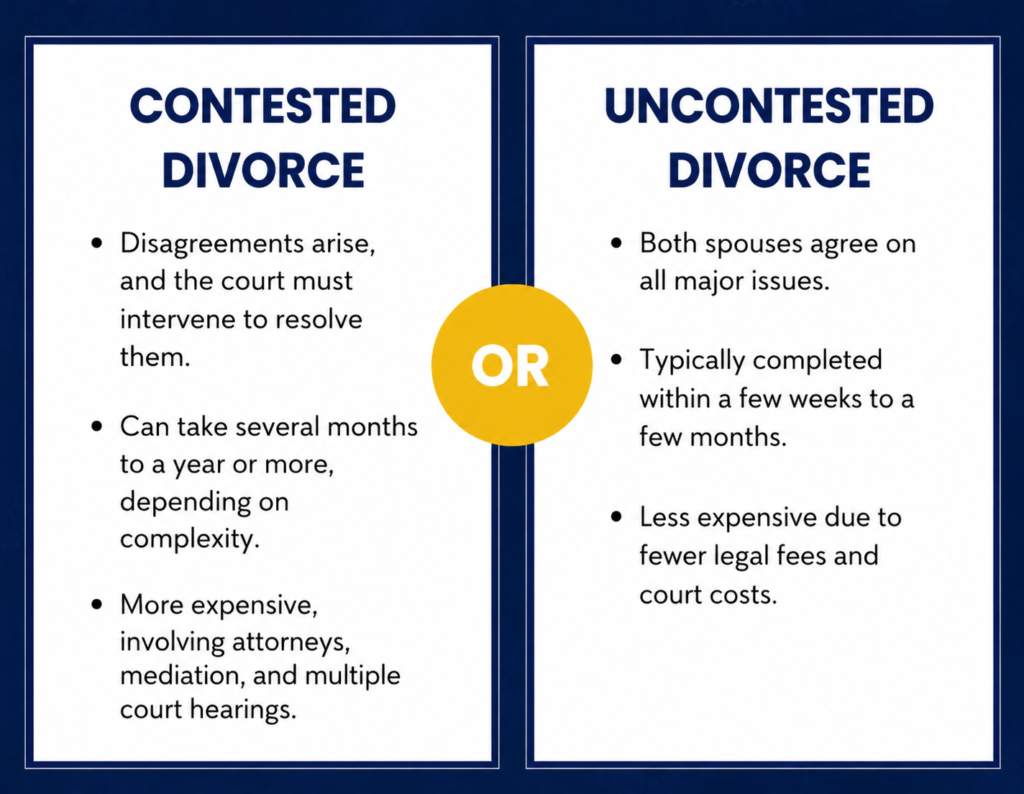
Choosing the right approach to your divorce depends on the level of agreement between you and your spouse and the complexity of the issues involved.
Choose an Uncontested Divorce Process When:
- Both spouses agree to the divorce and have no significant disputes about related issues
- A separation agreement has been or can be reached covering custody, support, and property matters
- The primary goal is to obtain the divorce order and certificate as efficiently as possible
- The marriage was relatively short or the financial and parenting circumstances are straightforward
Expect a More Complex Process When:
- Significant disputes exist regarding the custody of children or decision-making responsibility
- Spousal support entitlement or quantum is in dispute
- There are complex assets including business interests, pensions, real property in multiple jurisdictions, or significant debt
- One party has concerns about financial disclosure or potential hidden assets
- There is a history of family violence or power imbalance that affects the fairness of negotiation
Professional legal assessment at the outset of the process helps you understand honestly which pathway your matter is likely to follow and what to prepare for.
7. Common Questions About Divorce Certificate Service
7.1. How long does it take to get a divorce in Ontario?
The minimum timeline for a divorce based on one year of separation is approximately four to six months from filing to the divorce order becoming final, assuming the application is uncontested and correctly prepared. Contested matters involving disputes about support, custody, or property typically take significantly longer. The divorce certificate itself is requested after the order becomes final, which occurs 31 days after the divorce order is granted.
7.2. Do both spouses have to agree to the divorce?
No. In Canada, one spouse can obtain a divorce even if the other spouse does not consent, provided the legal requirements are met. An uncontested divorce is simpler and faster, but the court can grant a divorce on the basis of one year of separation regardless of the other spouse’s position on the divorce itself.
7.3. Can I get divorced in Ontario if I was married in another country?
Yes, provided at least one spouse has been ordinarily resident in Ontario for at least one year immediately before the divorce application is filed. Canadian courts have jurisdiction to dissolve foreign marriages provided the residency requirement is met.
7.4. Do I need a separation agreement before I can apply for divorce?
No. A separation agreement is not a prerequisite for filing a divorce application. However, addressing related issues including support and property through a separation agreement or consent order before or alongside the divorce application is strongly advisable to protect your legal rights.
7.5. What is the difference between a divorce order and a divorce certificate?
A divorce order is the court’s judgment dissolving the marriage. A divorce certificate is a separate document issued upon request that officially certifies the divorce. The certificate is what most institutions and authorities, including immigration authorities and marriage license offices, require as proof of divorce. Professional divorce certificate service includes guidance on applying for the certificate after your order becomes final.
8. Move Forward with Confidence: Book Your Free Divorce Certificate Service Consultation Today

Divorce is one of the most significant legal events in a person’s life, and the decisions made during the process have consequences that extend for years. Whether your matter is straightforward and uncontested or involves complex disputes about children, support, and property, professional legal guidance ensures that you understand your rights, that your application is prepared correctly, and that the outcome of the process serves your long-term interests.
When you work with KT Law Firm’s divorce certificate service, you receive:
- Free initial consultation to assess your situation, explain your options, and outline a clear path forward
- Complete divorce application preparation and filing in compliance with all Ontario court requirements
- Guidance on obtaining your official divorce certificate after your order becomes final
- Separation agreement preparation and review to protect your rights and ensure the agreement is legally sound and enforceable
- Support with related matters including child custody, child support, spousal support, and property division
- Negotiation support aimed at achieving fair and practical resolutions without unnecessary litigation
- Court representation when disputes require formal proceedings to resolve
- Clear, compassionate guidance throughout the entire process in both English and Vietnamese
Divorce is difficult enough without the added stress of navigating a complex legal process alone. At KT Law Firm, our goal is to make the divorce certificate service process as straightforward and stress-free as possible while ensuring your legal rights are fully protected from start to finish.
Contact KT Law Firm today to book your free consultation and take the first step toward moving forward with clarity, confidence, and the professional legal support you deserve.