
Landlord and Tenant Board Service in Ontario: Guide to Navigating Rental Disputes

Landlord and tenant board service is the professional solution that helps landlords and tenants in Ontario navigate the formal dispute resolution process of the Landlord and Tenant Board, prepare compelling evidence, meet strict procedural deadlines, and achieve enforceable outcomes in matters involving evictions, unpaid rent, maintenance failures, illegal landlord conduct, and a wide range of other residential tenancy disputes. With virtual hearings, complex application forms, and adjudicators who expect parties to be procedurally prepared, appearing before the LTB without professional guidance frequently results in dismissed applications, unfavorable orders, and outcomes that a well-prepared party could have avoided.
1. What Is a Landlord and Tenant Board Service and Why You Need Professional Help
The Landlord and Tenant Board is a legal tribunal under Tribunals Ontario that resolves disputes between landlords and tenants in Ontario under the Residential Tenancies Act, 2006. Unlike informal complaints or private negotiations, the LTB process produces formal, legally binding, and enforceable orders. An eviction order issued by the LTB can be enforced through the Court Enforcement Office. A payment order can be enforced through the courts. A finding against either party carries real and lasting legal consequences that cannot simply be appealed away without grounds.

This is not a process where showing up and telling your side of the story is sufficient. LTB hearings are conducted by adjudicators who apply the Residential Tenancies Act strictly. Parties who do not understand the relevant legal provisions, who cannot present their evidence in a clear and organized manner, or who fail to meet notice and filing requirements before the hearing frequently discover that the strength of their underlying position makes no difference if it is not properly established on the record.
A professional landlord and tenant board service does far more than help you complete a form. A qualified legal professional will assess the strength of your position under the Residential Tenancies Act, identify the correct application and notice type for your situation, ensure all procedural steps are completed correctly and on time, prepare your evidence strategically, and represent you at the hearing with the clarity and procedural knowledge that LTB adjudicators expect from parties appearing before them.
At KT Law Firm, we provide practical and results-driven legal support for both landlords and tenants at every stage of the LTB process, from serving the initial notice through to enforcement of the final order.
2. Understanding the Landlord and Tenant Board: What You Need to Know
Before filing any application or responding to any notice, it is essential to understand how the LTB operates, what types of disputes fall within its jurisdiction, and what the procedural process looks like from beginning to end.

2.1. The LTB’s Role and Jurisdiction
The LTB has exclusive jurisdiction to resolve residential tenancy disputes in Ontario under the Residential Tenancies Act, 2006. This means that landlords cannot evict tenants through the regular court system, and tenants cannot pursue most rental-related claims through Small Claims Court. The LTB is the designated and mandatory forum for the disputes that fall within its jurisdiction, and understanding what falls within that jurisdiction is the essential first step in any landlord or tenant matter.
The LTB handles four broad categories of disputes: eviction applications brought by landlords, tenant rights applications brought by tenants, financial disputes involving unpaid rent, compensation, and rent abatements, and applications addressing illegal actions by either party.
2.2. Common Landlord Applications: Evictions and Beyond
Landlords must apply to the LTB to legally evict a tenant. A notice of termination served on a tenant is not an eviction. Only the LTB can issue a binding eviction order, and landlords who attempt to evict tenants without a valid LTB order expose themselves to serious legal liability.
Common reasons for landlord applications include:
- Non-payment of rent: The landlord serves an N4 notice and, if rent is not paid within the notice period, files an L1 application for eviction and payment of arrears
- Persistent late payment of rent: Repeated late payments may support an application under different grounds even if the tenant eventually pays
- Damage to the rental unit: Documented damage beyond normal wear and tear supports a notice and application for compensation and potentially eviction
- Illegal activity in the unit: Verified illegal activity on the premises can support expedited proceedings
- Landlord’s own use: An N12 notice may be served when the landlord, their family member, or a purchaser requires the unit for personal residence, subject to strict good faith requirements
- Major renovation or demolition: An N13 notice is required when the landlord needs vacant possession for renovations requiring a building permit or for demolition
2.3. Common Tenant Applications: Rights and Remedies
Tenants have their own rights under the Residential Tenancies Act and their own application types to enforce those rights when landlords fail to meet their legal obligations:
- Failure to maintain or repair: A T6 application addresses a landlord’s failure to keep the rental unit and common areas in a good state of repair and fit for habitation
- Harassment, illegal entry, or coercion: A T2 application covers a range of landlord conduct including entering the unit without proper notice, harassing the tenant, changing locks without authorization, and attempting to coerce the tenant into leaving
- Illegal rent increases: A T1 application addresses rent charged above the allowable guideline or charges that are not permitted under the Act
- Withholding vital services: Landlords who cut off heat, water, electricity, or other essential services are subject to LTB applications and significant penalties
- Bad faith eviction: Where a landlord served an N12 for personal use but did not genuinely intend to occupy the unit, the tenant may apply for substantial compensation
2.4. The Step-by-Step LTB Process
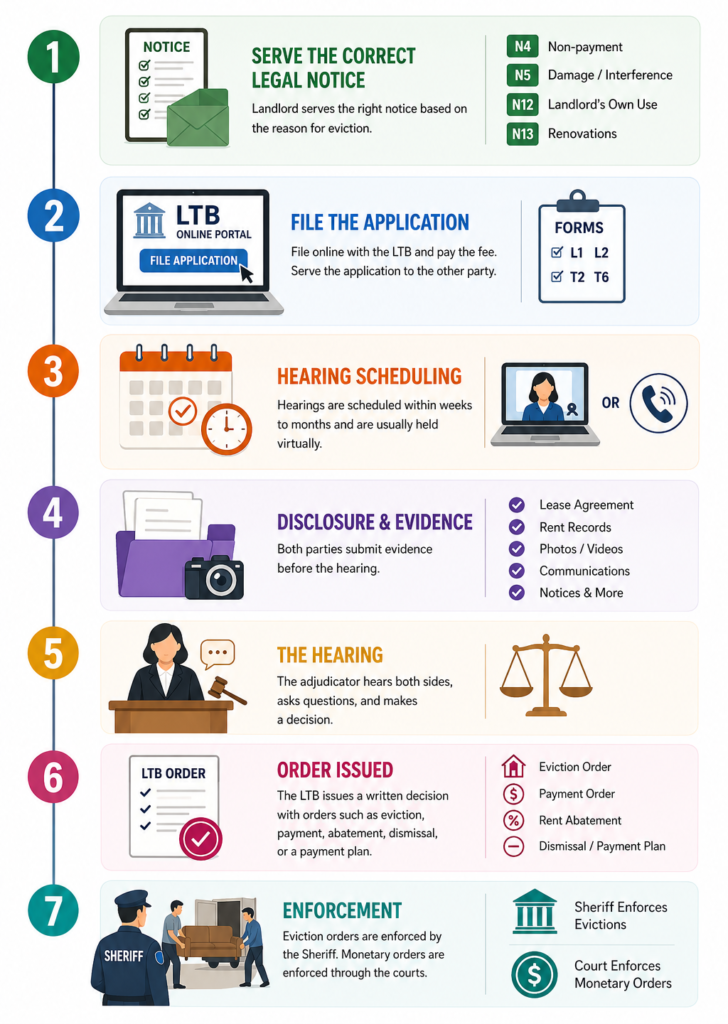
Step 1: Serve the Correct Legal Notice
Before filing an application, the landlord must serve the appropriate termination notice on the tenant. The correct notice type depends on the grounds being relied upon: N4 for non-payment, N5 for damage or interference, N12 for landlord’s own use, N13 for renovations. Each notice has its own required content, notice period, and service requirements. A notice that is incorrect in any of these respects may be challenged at the hearing.
Step 2: File the Application
Applications are filed through the LTB’s online portal with the applicable filing fee. Common landlord forms include the L1 for eviction and rent arrears and the L2 for other eviction grounds. Common tenant forms include the T2 for tenant rights violations and the T6 for maintenance issues. The application must be served on the other party in compliance with LTB rules.
Step 3: Hearing Scheduling
Hearings are typically scheduled within weeks to months of the application being filed, depending on the type of application and current LTB volumes. Most hearings are conducted virtually by Zoom or telephone.
Step 4: Disclosure and Evidence Preparation
Both parties must organize and submit their evidence before the hearing deadline. Strong evidence typically includes the lease agreement, rent payment records, photographs and videos of the unit, written communications including emails and text messages, copies of notices served, and witness statements where applicable.
Step 5: The Hearing
Hearings are conducted by an LTB adjudicator who hears arguments from both parties, asks questions, and assesses the evidence. Legal representatives are permitted and frequently make a decisive difference in how effectively a party’s position is presented and how well opposing arguments are challenged.
Step 6: Order Issued
The LTB issues a written decision that may include an eviction order, a payment order, a rent abatement, a dismissal, or conditional orders such as a payment plan allowing the tenant to void the eviction by paying arrears within a specified period.
Step 7: Enforcement
Eviction orders are enforced through the Court Enforcement Office, which works with the Sheriff to carry out the physical eviction. Landlords cannot evict tenants themselves under any circumstances. Monetary orders can be enforced through the courts using standard judgment enforcement mechanisms.
3. Why Parties Who Handle LTB Matters Without Professional Help Achieve Worse Outcomes

The LTB process is designed to be accessible to self-represented parties, but accessible and straightforward are not the same thing. Here are the most common reasons self-represented landlords and tenants achieve worse outcomes than their legal position should produce:
3.1. Serving an Incorrect or Defective Notice
The notice is the foundation of every landlord application. A notice that uses the wrong form, contains incorrect information, is served on the wrong date, or does not allow the correct notice period is a defective notice. Adjudicators take notice defects seriously, and a significant procedural error at the notice stage can result in the application being dismissed even when the underlying grounds are valid, requiring the landlord to start the entire process again.
3.2. Failing to Prepare and Organize Evidence Effectively
LTB adjudicators assess applications based on the evidence presented. Parties who arrive at hearings with disorganized documents, no clear narrative connecting their evidence to the legal grounds they are relying on, or who fail to submit evidence before the required deadline are routinely unable to make the most of their legal position. The strength of a case on the facts is only as good as the evidence that establishes those facts on the record.
3.3. Not Understanding the Relevant Legal Test
Every LTB application type requires the applicant to establish specific facts that meet a defined legal test under the Residential Tenancies Act. A landlord applying under an N12 for personal use must establish genuine good faith intent to occupy the unit. A tenant applying under a T6 for maintenance failures must establish that the landlord knew of the problem and failed to address it within a reasonable time. Parties who present evidence without understanding the specific legal test they need to satisfy frequently fail to establish elements that were actually within their ability to prove.
3.4. Ineffective Cross-Examination and Response to Opposing Evidence
Hearings are adversarial proceedings where both parties have the opportunity to challenge the other’s evidence and testimony. Self-represented parties who do not know how to cross-examine the opposing party effectively, how to object to inadmissible or irrelevant evidence, or how to respond to the adjudicator’s questions clearly and concisely are at a structural disadvantage regardless of the merits of their case.
3.5. Missing Deadlines and Procedural Requirements
The LTB operates on specific timelines: notice periods that must be respected before filing, evidence submission deadlines before hearings, and response periods for parties served with applications. Missing any of these deadlines can have serious procedural consequences including the loss of the right to raise certain arguments or present certain evidence at the hearing.
4. How Professional Landlord and Tenant Board Services Maximize Your Success

4.1. Case Assessment and Legal Strategy
Before any notice is served or application filed, a professional assessment determines whether the grounds being relied upon are legally sufficient under the Residential Tenancies Act, what evidence is required to establish those grounds at a hearing, what procedural steps must be completed in what order and within what timeframes, and what outcome is realistically achievable given the specific facts of the matter.
4.2. Correct Notice Preparation and Service
Professional landlord and tenant board service ensures that the correct notice type is selected for the grounds being relied upon, that the notice contains all required information in the correct format, that the notice period is calculated accurately, and that service is completed in a manner that complies with LTB rules and can be established at the hearing if challenged.
4.3. Application Preparation and Filing
Professional services ensure that the LTB application is completed accurately and completely, that the correct application type is selected to match the notice and grounds being relied upon, that all required information is included, and that the application is filed and served in compliance with LTB procedural requirements.
4.4. Evidence Preparation and Organization
A well-organized evidence package is one of the most significant factors in LTB hearing outcomes. Professional legal support helps parties identify all relevant evidence, organize it in a clear and logical format that supports the legal argument being advanced, ensure photographs and videos are properly dated and identified, compile communication records effectively, and submit the complete evidence package before the hearing deadline.
4.5. Hearing Representation
At the LTB hearing itself, professional representation ensures that your legal arguments are presented clearly and in terms that directly address the legal test the adjudicator must apply, that the opposing party’s evidence and arguments are challenged effectively through cross-examination, that procedural objections are raised when appropriate, and that your complete position is fully articulated on the record in the time available.
5. The KT Law Firm Advantage: Why Experience Matters

When it comes to landlord and tenant board service, procedural knowledge, evidence preparation, and hearing strategy are the foundations of every favorable outcome.
5.1. Clear, Strategic Legal Guidance
KT Law Firm provides direct, practical guidance on every aspect of the LTB process. We explain what the law requires, what evidence is needed, what the realistic outcomes are for your specific matter, and what steps we are taking at every stage. Our clients are never left uncertain about the status of their case or what is expected of them.
5.2. Representation for Both Landlords and Tenants
We provide professional landlord and tenant board service for both sides of residential tenancy disputes. Landlords facing non-payment of rent, property damage, or situations requiring eviction receive the same level of professional preparation and hearing representation as tenants facing bad faith evictions, maintenance failures, illegal landlord conduct, or illegal rent increases. The law protects both parties, and we ensure both parties have the professional support they need to enforce their rights effectively.
5.3. Experience with Diverse LTB Matters
Our work includes matters involving non-payment and rent arrears, landlord’s own use applications and bad faith challenges, maintenance and repair disputes, harassment and illegal entry claims, illegal lockout situations requiring emergency action, and complex financial disputes involving rent abatements and compensation claims.
5.4. Efficient and Cost-Conscious Approach
LTB matters, like Small Claims Court disputes, are fundamentally about practical outcomes. We approach every matter with a focus on achieving the best possible result efficiently, using professional resources proportionate to what is actually at stake in the dispute and the complexity of the legal issues involved.
5.5. Support in English and Vietnamese
Our team provides professional support in both English and Vietnamese throughout the entire landlord and tenant board service process, ensuring that every client fully understands their rights, the procedural status of their matter, and the strategy being pursued on their behalf.
6. Landlord Application vs. Tenant Application: Different Rights, Same Standard of Preparation

Whether you are a landlord pursuing an eviction or a tenant defending your right to remain in your home, the standard of preparation required to achieve a good outcome before the LTB is equally demanding.
If You Are a Landlord:
- Every notice must be correct in form, content, and service before an application can proceed
- Evidence of grounds must be documented specifically and chronologically
- Good faith requirements for personal use applications must be understood and established clearly
- Enforcement of the eviction order after it is issued requires a separate process through the Court Enforcement Office
If You Are a Tenant:
- You have the right to dispute any notice and any application filed against you
- Evidence of your payment history, the condition of the unit, and the landlord’s conduct can all be decisive
- Compensation and rent abatement applications have their own evidentiary requirements
- Bad faith eviction defences require specific evidence of the landlord’s lack of genuine intent
In both situations, the quality of professional preparation determines whether the outcome reflects the actual legal position of the party or simply the better-prepared party on the day.
7. Common Questions About Landlord and Tenant Board Service
7.1. Can a landlord evict a tenant without going to the LTB?
No. In Ontario, a landlord cannot legally evict a tenant without a valid eviction order issued by the LTB. Serving a notice of termination is not sufficient. Attempting to evict a tenant without an LTB order, including changing locks, removing the tenant’s belongings, or cutting off services, exposes the landlord to significant legal liability under the Residential Tenancies Act.
7.2. How long does an LTB eviction process take?
Timeline varies depending on the type of application and current LTB scheduling. Notice periods range from 7 to 60 days depending on the grounds. Hearing dates are typically scheduled within one to four months of the application being filed. Orders are generally issued within one to four weeks after the hearing. Total timeline from serving the initial notice to an enforceable eviction order is commonly several months.
7.3. Can a tenant be evicted for not paying rent if they offer to pay at the hearing?
Under the Residential Tenancies Act, a tenant who owes rent arrears may be able to void an eviction order by paying the full amount owed, including filing fees, before the order takes effect or before the enforcement date specified in a conditional order. The specific terms depend on the order issued by the adjudicator. Professional advice before the hearing helps both landlords and tenants understand how conditional order provisions work and what to expect.
7.4. What can a tenant do if their landlord illegally locked them out?
An illegal lockout, meaning a landlord changing locks or preventing the tenant’s access to the unit without an LTB order, is a serious violation of the Residential Tenancies Act. The tenant can file an urgent T2 application with the LTB seeking immediate restoration of access and compensation. Situations involving illegal lockouts may qualify for expedited hearing scheduling given their urgent nature.
7.5. Can a landlord raise the rent by any amount they choose?
No. Rent increases in Ontario are governed by the annual rent increase guideline set by the provincial government. Landlords cannot increase rent by more than the guideline amount without LTB approval through an Above Guideline Increase application. Rent increases also require proper notice served at least 90 days before the increase takes effect. Illegal rent increases can be challenged through a tenant application to the LTB.
8. Do Not Face the LTB Alone: Book Your Free Landlord and Tenant Board Service Consultation Today

Whether you are a landlord dealing with a tenant who has stopped paying rent, a landlord who needs to recover possession of your property in good faith, a tenant facing an eviction you believe is unjust, or a tenant whose landlord has failed to maintain your unit or violated your legal rights, the LTB process requires preparation, procedural knowledge, and effective advocacy that most parties do not possess without professional support.
When you work with KT Law Firm’s landlord and tenant board service, you receive:
- Free initial consultation to assess your matter, identify your legal rights and options, and develop a clear strategy for your specific situation
- Correct notice preparation and service to ensure the foundation of your application is procedurally sound from the start
- Complete LTB application preparation and filing in compliance with all procedural requirements
- Strategic evidence organization and preparation to ensure your strongest case is clearly presented at the hearing
- Professional representation at your LTB hearing with the procedural knowledge and advocacy skills that make a decisive difference in outcome
- Guidance on enforcement of orders after the hearing, whether through the Court Enforcement Office for evictions or through the courts for monetary orders
- Efficient, cost-conscious approach proportionate to the practical stakes of your dispute
- Support available in both English and Vietnamese throughout the entire landlord and tenant board service process
If you are dealing with a residential tenancy dispute in Ontario, do not wait. Limitation periods apply, notice deadlines are unforgiving, and the strength of your legal position depends entirely on how well it is prepared and presented before the LTB.
Contact KT Law Firm today to book your free landlord and tenant board service consultation and explore your options with the confidence that comes from having experienced, dedicated legal professionals on your side.