
Small Claims Court Service in Canada Guide to Pursuing and Defending Claims with Confidence

Small claims court service is the professional solution that helps individuals and businesses navigate the Small Claims Court process efficiently, whether they are recovering unpaid debts, resolving contract disputes, or defending against claims that threaten their financial interests. With procedural rules, strict filing deadlines, and evidence requirements that can overwhelm self-represented parties, approaching Small Claims Court without legal guidance frequently results in poorly prepared claims, missed opportunities for settlement, and outcomes that could have been avoided entirely.
1. What Is a Small Claims Court Service and Why You Need Professional Help
Small Claims Court is a division of the civil court system specifically designed to resolve lower-value disputes in a faster and more accessible manner than higher courts. In Ontario, the court handles claims involving amounts of up to $50,000, making it the appropriate forum for a wide range of everyday legal disputes involving individuals, businesses, landlords, tenants, contractors, and service providers.
While Small Claims Court is intentionally designed to be more accessible than superior court proceedings, accessible does not mean simple. Parties who appear without legal preparation frequently discover that the process involves filing deadlines that cannot be missed, procedural rules that must be followed precisely, evidence standards that determine what a judge can and cannot consider, and negotiation and settlement dynamics that require both legal knowledge and practical strategy to navigate effectively.
The consequences of poor preparation in Small Claims Court are real and lasting. A plaintiff who files an incomplete or legally insufficient claim may have it dismissed or reduced significantly by the court. A defendant who fails to respond correctly or misses a deadline may have a default judgment entered against them without ever having the opportunity to present their side of the dispute. Neither outcome reflects the actual merits of the case. Both are entirely avoidable with professional legal support.
A professional small claims court service does far more than help you fill out court forms. A qualified legal professional will assess the strength of your claim or defence, identify the most effective legal arguments and evidence, manage all procedural requirements on your behalf, pursue settlement opportunities strategically, and represent you in court when a hearing is required.
At KT Law Firm, we provide practical and results-driven legal support for matters before the Small Claims Court, committed to helping every client navigate the process efficiently and with confidence from the first filing through to final resolution.
2. Understanding Small Claims Court: What You Need to Know
Before pursuing or defending a Small Claims Court matter, it is important to understand how the court operates, what types of disputes fall within its jurisdiction, and what the process involves from start to finish.

2.1. Jurisdiction and Monetary Limits
In Ontario, Small Claims Court has jurisdiction over civil disputes involving claims for money or the return of personal property up to a value of $50,000, exclusive of interest and costs. Claims that exceed this limit must either be reduced to fit within the Small Claims Court jurisdiction or pursued in a higher court, which involves significantly greater procedural complexity and cost.
It is important to note that not all disputes belong in Small Claims Court even if the amounts involved fall within the monetary limit. Certain matters, including many landlord and tenant disputes, are handled by specialized tribunals such as the Landlord and Tenant Board. Understanding which forum is appropriate for your specific dispute is an essential first step, and professional guidance ensures you file in the right place from the beginning.
2.2. The Small Claims Court Process
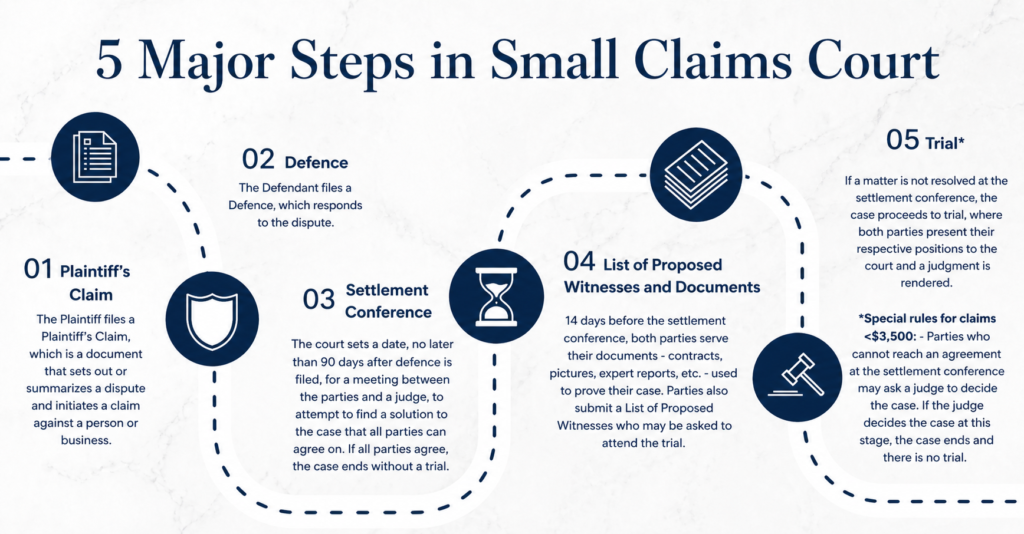
While the specifics of each case vary, the general Small Claims Court process follows a structured sequence:
Filing the Plaintiff’s Claim: The party pursuing the claim, the plaintiff, begins by completing and filing a Plaintiff’s Claim form with the court, paying the required filing fee, and having the claim served on the opposing party, the defendant, within the required timeframe.
The Defendant’s Response: Once served, the defendant has a defined period to file a Defence. A defendant who fails to respond within the deadline risks having a default judgment entered against them. A defendant who wishes to pursue their own claim against the plaintiff may also file a Defendant’s Claim at this stage.
Settlement Conference: Before any trial takes place, the court schedules a mandatory Settlement Conference, where a judge or deputy judge meets with both parties to explore whether the dispute can be resolved without a full hearing. Settlement conferences are a critical stage where legal preparation and negotiation strategy can have a significant impact on outcome.
Trial: If the matter is not resolved at the Settlement Conference, it proceeds to a trial where both parties present their evidence and arguments to a judge, who then renders a decision.
Enforcement: Winning a judgment does not automatically result in payment. If the losing party does not pay voluntarily, the successful party must take additional enforcement steps to collect the judgment, including garnishment of wages or bank accounts and the seizure and sale of assets.
2.3. Key Limitation Periods
One of the most critical aspects of any Small Claims Court matter is the limitation period, the deadline by which a claim must be filed. In Ontario, the basic limitation period for most civil claims is two years from the date the claimant knew or ought to have known that a claim existed. Missing this deadline can permanently bar you from pursuing your claim regardless of its merits. Professional legal guidance ensures limitation periods are identified and respected from the outset.
3. Why Most Self-Represented Small Claims Court Cases Fall Short

Small Claims Court is designed to be accessible to self-represented parties, but designed for accessibility and suitable for self-representation are not the same thing. Here are the most common reasons self-represented parties achieve worse outcomes than the facts of their case should produce:
3.1. Filing an Insufficient or Legally Flawed Claim
A Plaintiff’s Claim must clearly identify the legal basis for the claim, the specific remedy being sought, and the facts that support entitlement to that remedy. Claims that are vague, legally incorrect, or that fail to identify all available heads of damages frequently result in reduced judgments or dismissals even when the underlying facts strongly favor the plaintiff.
3.2. Failure to Gather and Present Evidence Effectively
Small Claims Court judges base their decisions on the evidence presented at trial. Many self-represented parties bring documents to court that are not properly authenticated, rely on witness accounts that are not formalized as witness statements, or fail to understand which types of evidence are admissible and how to present them effectively. Evidence that exists but is not properly presented carries no weight in the judge’s decision.
3.3. Missing the Strategic Value of the Settlement Conference
Settlement conferences are a significant opportunity to resolve disputes on favorable terms without the cost, time, and uncertainty of a full trial. Self-represented parties who attend Settlement Conferences without legal preparation frequently fail to articulate the strengths of their position effectively, agree to settlements that are below what a well-prepared party could have achieved, or miss opportunities to identify weaknesses in the opposing party’s case that could have been leveraged in negotiation.
3.4. Inadequate Defence Preparation
Defendants who receive a Plaintiff’s Claim frequently underestimate how much preparation is required to mount an effective defence. A well-pleaded defence must respond specifically to the factual allegations in the claim, identify applicable legal defences, and lay the groundwork for the evidence the defendant intends to rely on at trial. A generic or incomplete Defence leaves the defendant in a weaker position at every subsequent stage of the proceeding.
3.5. Failure to Enforce a Judgment After Winning
Many successful plaintiffs discover after receiving a favorable judgment that collecting the money owed requires additional legal steps. Enforcement mechanisms including wage garnishment, bank account garnishment, and examination of the debtor are procedurally specific and require correct completion of additional court forms and processes. A judgment that is never enforced is a judgment that produces no practical benefit.
4. How Professional Small Claims Court Services Maximize Your Success

4.1. Case Assessment and Legal Strategy
Before any documents are filed, a professional assessment of your matter determines the strength of your legal position, the most appropriate legal theory for your claim or defence, the evidence that will be most persuasive to the court, realistic expectations for outcome, and whether negotiated settlement is a viable and preferable alternative to litigation. This assessment shapes every subsequent decision in the proceeding.
4.2. Drafting Claims and Defences
Professional legal drafting ensures that your Plaintiff’s Claim or Defence is legally sufficient, factually comprehensive, and strategically framed to present your position in the strongest possible light. This includes identifying all available legal arguments, quantifying damages accurately and completely, anticipating the opposing party’s likely responses, and ensuring the document complies with all court requirements for format and content.
4.3. Evidence Gathering and Organization
Professional small claims court service includes practical guidance on gathering, organizing, and presenting the evidence that will support your position at trial. This includes identifying which documents need to be produced, how witness evidence should be prepared and presented, and how to address situations where key evidence is in the possession of the opposing party or a third party.
4.4. Settlement Conference Preparation and Negotiation
We prepare clients thoroughly for Settlement Conferences, ensuring they understand the strengths and weaknesses of their position, the realistic range of outcomes if the matter proceeds to trial, and the negotiation strategy most likely to produce a favorable resolution. Where settlement is in the client’s best interest, we pursue it actively and with legal precision. Where it is not, we prepare to proceed to trial from a position of strength.
4.5. Court Representation
When a matter proceeds to trial, professional legal representation ensures that your evidence is presented effectively, procedural requirements are met, objections are raised and responded to correctly, and your legal arguments are articulated clearly and persuasively to the judge. The difference between a well-represented party and a self-represented one is frequently visible in the outcome.
5. The KT Law Firm Advantage: Why Experience Matters

When it comes to small claims court service, practical legal experience and strategic preparation are what separate parties who achieve favorable outcomes from those who leave court wondering what went wrong.
5.1. Clear, Strategic Legal Guidance
KT Law Firm provides legal guidance that is direct, practical, and strategically focused on achieving the best possible outcome for your specific dispute. We do not provide generic advice. We assess your matter individually and develop an approach tailored to the facts, the applicable law, and the realistic dynamics of your case.
5.2. Efficient and Cost-Conscious Approach
We understand that Small Claims Court matters are fundamentally about value. The goal is not simply to win, but to achieve an outcome that is worth the time and resources invested in pursuing it. Our approach is designed to be efficient, targeted, and proportionate to the amount at stake, ensuring that the cost of professional legal support makes practical sense for your situation.
5.3. Experience with Diverse Civil Disputes
Our small claims court service covers a wide range of dispute types, including unpaid debts and personal loans, breach of contract in both personal and commercial contexts, property damage claims, construction and home renovation disputes involving contractors and workmanship issues, business and commercial conflicts, security deposit and refund disputes, landlord-related financial claims outside tribunal jurisdiction, and limited defamation matters where monetary damages are sought within the court’s jurisdictional limit.
5.4. Dedicated Representation from Start to Finish
We do not hand clients off between team members or provide support only at specific stages of the proceeding. KT Law Firm provides dedicated, consistent legal support from the initial case assessment through to final resolution, whether that resolution comes through settlement at the conference stage, a favorable trial judgment, or successful enforcement of a judgment already obtained.
5.5. Support in English and Vietnamese
Our team provides professional legal support in both English and Vietnamese, ensuring that language is never a barrier to understanding your legal rights, the status of your matter, or the strategic options available to you at each stage of the proceeding.
6. Pursuing a Claim vs. Defending a Claim: Different Challenges, Same Standard of Preparation
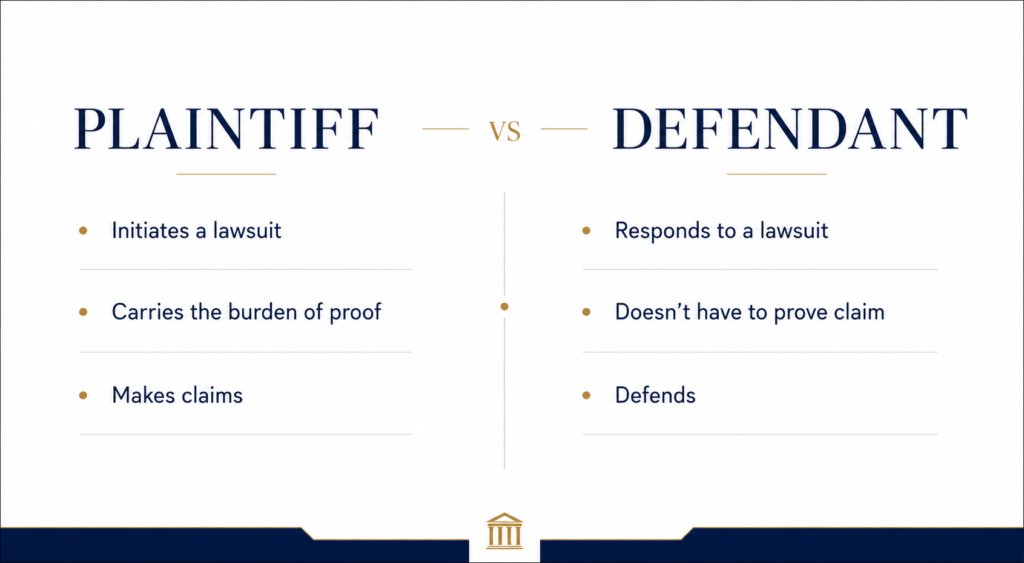
Whether you are the party pursuing a claim or the party defending against one, the standard of preparation required to achieve a good outcome is equally high.
If You Are Pursuing a Claim:
- Your claim must be filed before the limitation period expires
- You must clearly establish the legal basis for your entitlement to the amount claimed
- You must produce evidence sufficient to prove your case on a balance of probabilities
- You must serve the claim correctly on the defendant within the required timeframe
- You must be prepared to negotiate at the Settlement Conference and present at trial if necessary
If You Are Defending a Claim:
- You must respond within the deadline to avoid a default judgment
- Your Defence must specifically address the factual allegations made against you
- You must identify and document all applicable legal defences
- You must consider whether you have your own claim against the plaintiff that should be filed as a Defendant’s Claim
- You must prepare your evidence and witnesses for the Settlement Conference and trial
In both situations, the quality of your preparation determines the quality of your outcome. Professional small claims court service ensures that neither a plaintiff nor a defendant enters the proceeding at a disadvantage that could have been avoided.
7. Common Questions About Small Claims Court Service
7.1. How much does it cost to file a Small Claims Court claim in Ontario?
Filing fees vary depending on the amount of the claim. As of current IRCC schedules, fees range from approximately $102 for claims up to $1,000 to $229 for claims between $10,000 and $50,000. Additional fees apply for issuing a Defendant’s Claim, filing a Defence, and certain enforcement steps. Professional legal service fees are separate and should be discussed transparently at the outset of your matter.
7.2. How long does a Small Claims Court case take to resolve?
Timeline varies significantly depending on the complexity of the dispute, the court’s scheduling availability, and whether the matter resolves at the Settlement Conference or proceeds to trial. Settlement Conference dates are typically scheduled several months after filing. Trial dates, if required, may be scheduled months after the Settlement Conference. Matters that settle early in the process can resolve much faster.
7.3. Can I recover my legal costs if I win?
Small Claims Court has specific rules about cost recovery. In general, the court may order the unsuccessful party to pay a portion of the successful party’s legal representation fees, typically up to 15 percent of the amount claimed, along with certain disbursements. Full cost recovery is not typical in Small Claims Court, which is why the efficiency and proportionality of your legal support matters.
7.4. What happens if the other party does not pay after I win a judgment?
A judgment does not guarantee immediate payment. If the unsuccessful party does not pay voluntarily, you must take enforcement steps through the court, including examination of the debtor to assess their financial situation, garnishment of wages or bank accounts, and in some cases the seizure and sale of personal property. Professional small claims court service includes guidance on enforcement options and assistance with the enforcement process.
7.5. Can a business use Small Claims Court?
Yes. Both individuals and businesses can pursue and defend claims in Small Claims Court, provided the amount in dispute falls within the court’s jurisdictional limit. Business disputes involving unpaid invoices, contract breaches, service failures, and commercial disagreements between partners or vendors are all matters we regularly assist with.
8. Book Your Free Small Claims Court Service Consultation

A legal dispute left unaddressed does not resolve itself. Whether you are owed money that a person or business has refused to pay, dealing with a contract that was not honored, facing property damage that someone else is responsible for, or defending against a claim that you believe is unfounded, the time to act is now.
When you work with KT Law Firm’s small claims court service, you receive:
- Free initial consultation to assess your matter, identify your legal options, and develop a realistic strategy
- Professional drafting of claims and defences that are legally sufficient, factually complete, and strategically framed
- Evidence guidance to ensure you are presenting the right documentation in the right way at every stage of the proceeding
- Settlement Conference preparation and negotiation support designed to achieve the best possible resolution without unnecessary trial cost
- Dedicated court representation when your matter proceeds to a hearing
- Judgment enforcement assistance to ensure that winning in court translates into actually recovering what you are owed
- Efficient, cost-conscious service proportionate to the value of your dispute
- Support available in both English and Vietnamese throughout the entire small claims court service process
If you are dealing with a legal dispute, do not wait. Limitation periods are running, deadlines matter, and the strength of your position depends on how well it is prepared and presented from the very beginning.
Contact KT Law Firm today to discuss your matter and explore your options with the confidence that comes from having experienced, dedicated legal professionals on your side.